This process began with a question,
not an answer.
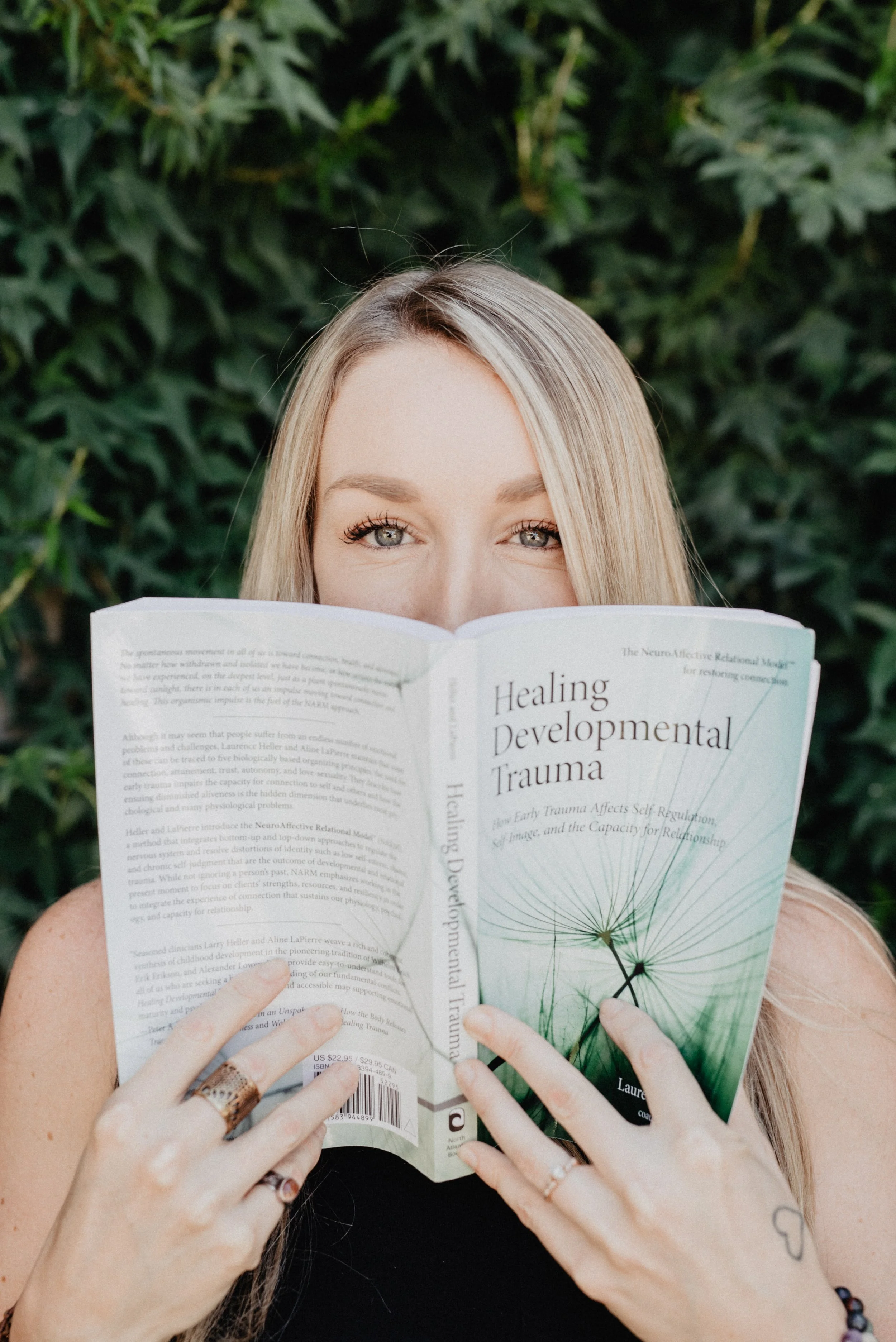
Lacey K. Kelly, LCSW — therapist, writer, and the person behind this work.
My name is Lacey, and I don’t understand people as broken, disordered, or incomplete.
I see people responding intelligently to the conditions they’ve lived inside, shaped by a culture that prizes performance, certainty, and forward motion over presence and contact. Shaped, too, by the relationships that formed them: the ones that made room for them, and the ones that didn't.
We are relational beings. We were born to be affected by the people around us. That is not a flaw in the design — it is the design. The difficulty is that sometimes the effect is that we are stifled, required to shrink, or handed identities that were never ours to carry. And we spend years believing that the weight of those identities is evidence of something wrong with us, rather than something that was asked of us.
My work is informed by clinical training, somatic awareness, and years of sitting with people at the edges of effort. More than any modality, though, it is shaped by a central observation: the feeling that something is wrong with you is almost never an innate flaw. It is the residue of relationships and a culture that required you to be less than you already are.
I don't work from the belief that you need to become someone new. My focus is on unbecoming the adaptations, the roles, and the identities that were installed by others. When those loosen, a sense of wholeness doesn't need to be engineered. It was always there. It just had a lot on top of it.
I also practice as a licensed clinical social worker in Arizona. That work — therapy and coaching for narcissistic abuse, complex trauma, and personality disorders — lives at Therapy with Lacey.
My Story of Unbecoming
I didn’t set out to create a philosophy or a framework. I was trying to understand something that wouldn’t leave me alone.
For as long as I can remember, there was an undercurrent of existential unrest. A sense that something essential was always just out of reach, even when life looked full on the surface. I kept asking the same questions in different forms:
What is the point of all this?
Why doesn’t this ever feel like enough?
Like many people, I responded in the way our culture rewards. I followed my passions. I built successful yoga studios. I poured myself into growth, achievement, and becoming someone I believed would finally feel whole. From the outside, my life looked aligned. Internally, the effort only intensified.
What I was chasing wasn’t something that could be earned, achieved, or resolved. The striving itself was shaping my suffering. I let go of the life I had built, stepped away from identities that required constant performance, and allowed myself to exist without proving anything. In that anonymity, I felt something I hadn’t felt before: space.
That was my first encounter with what I now call unbecoming.
Over time, as I sat with clients in their most unguarded moments, the larger pattern became impossible to ignore. The same exhaustion. The same relentless effort. The same belief that something essential had gone missing and needed to be recovered through work.
And then, slowly, something else came into focus. The unrest wasn't just philosophical. It wasn't just the culture, or the striving, or the performance. For many of us — myself included — it had a more specific origin. It came from relationships that required us to organize ourselves around someone else's reality. From being shaped, over years, into a version of ourselves that was built for someone else's comfort.
Understanding that didn't make the relationships wrong or the people in them villains. We are all human. We are all shaped. We are all, in some way, passing along the adaptations we inherited. But it did something important: it moved the question. From what is wrong with me to what was asked of me — and whether I was still willing to keep paying that cost.
What I was witnessing — in myself and in my clients — wasn't pathology.
It was what happens when the human condition is treated as a problem, and when the weight of what we were asked to carry gets mistaken for a personal defect.
The Process of Unbecoming emerged from all of this — not as a solution, but as a refusal. A refusal to keep participating in the idea that being human needs fixing. And an insistence that the wholeness we are all looking for was never actually missing. It just got buried under everything we were asked to become.
Unbecoming doesn't offer a new identity. It asks a sharper question:
What if nothing essential is missing?
What if the unrest you carry isn't a personal failure, but the weight of an identity that was never yours?
Schedule a Consultation
If you’re interested in working together through The Hub or Therapy with Lacey, reach out for a consultation call and I’d be happy to answer any questions you have.